Exploring the Science of Cannabinoid Formulations

Updated: Mar 7
Written by Jesse Cole Christianson, DNP, APRN, AGPCNP-BC Cannabinoid Science Educator | Founder, Dr. Murse/CannabisDNP
Cannabinoids have captured a lot of attention lately — and for good reason. These plant-based compounds are among the most actively studied natural molecules in modern science. But what actually goes into creating a thoughtful cannabinoid formulation? How do evidence-informed practitioners ensure these products are both well-crafted and responsibly made?
As a board-certified Nurse Practitioner with advanced training in cannabinoid science, these are the questions that drive every decision I make at Dr. Murse/CannabisDNP. Let's break it down.
What Is a Cannabinoid Formulation?
A cannabinoid formulation is a carefully designed product containing specific cannabinoids — like THC, CBD, CBG, and others — developed with intentional ratios, delivery methods, and complementary ingredients such as terpenes.
What separates a thoughtfully crafted formulation from a generic product is precision and purpose. The cannabinoid profile, the terpene selection, the delivery format, and the dosing are all deliberate decisions — not defaults.
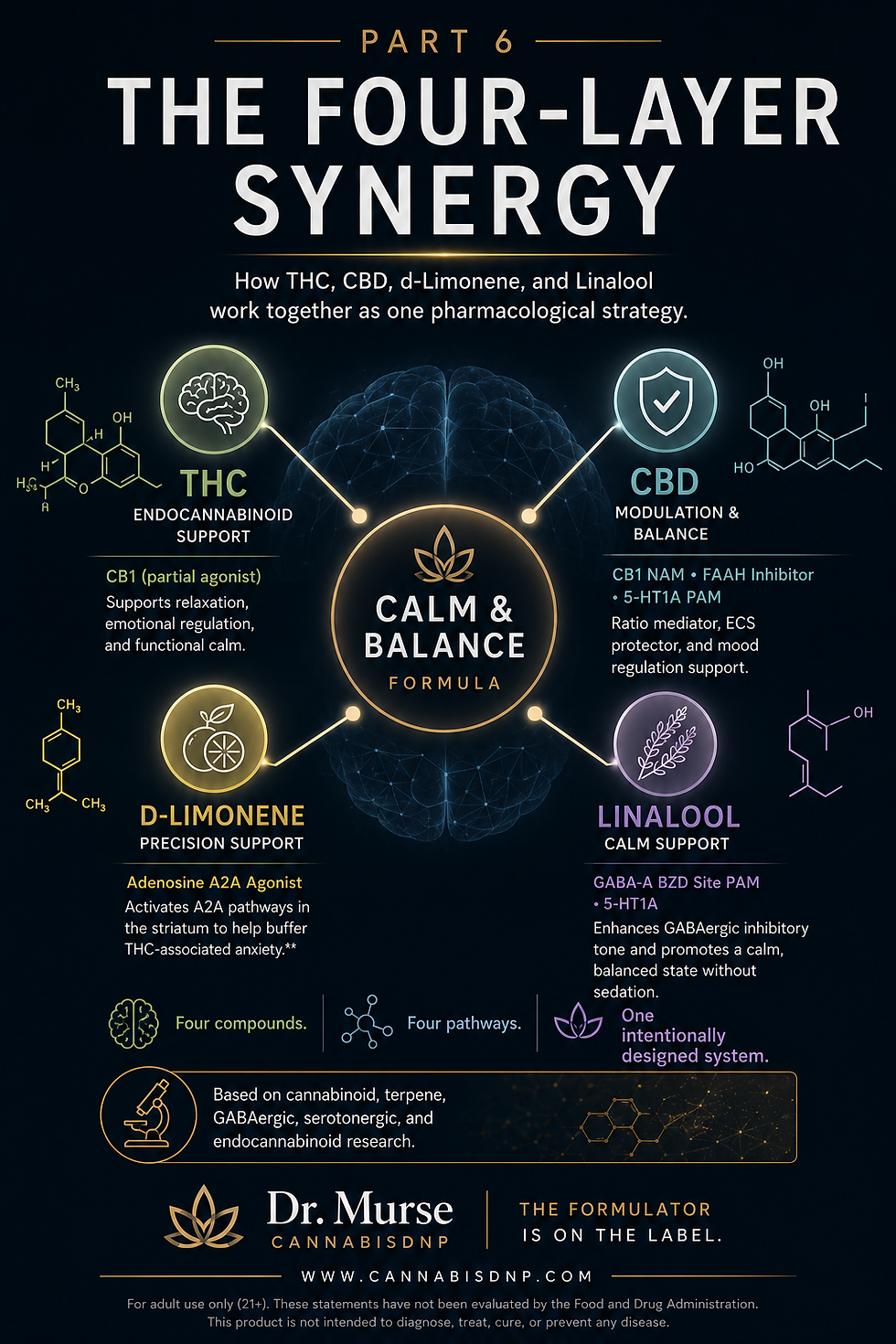
For example, a formulation built around everyday calm might emphasize elevated amounts of CBD alongside serotonin-pathway terpenes like linalool and D-limonene. A formulation designed for evening wind-down might combine low-dose Delta-9 THC with beta-myrcene and beta-caryophyllene, terpenes being studied for their relationship with the body's natural relaxation response. These are not arbitrary pairings. They reflect the available cannabinoid and terpene literature.

Cannabinoid extraction is key to creating effective formulations.
The Science Behind the Formulation
Cannabinoid Profile
The specific cannabinoids included — and their ratios — are the foundation of any formulation. Each cannabinoid interacts with the endocannabinoid system differently:
CBD functions as a negative allosteric modulator at CB1 receptors and interacts with 5-HT1A serotonin receptors — making it a subject of significant research interest for everyday calm
Delta-9 THC binds directly to CB1 receptors in the brain and is one of the most studied cannabinoids for its relationship with the body's pain signaling and sleep pathways
CBG interacts with both CB1 and CB2 receptors, as well as alpha-2 adrenoceptors and 5-HT1A receptors — giving it a mechanistically distinct profile from both CBD and THC
Terpenes
Terpenes are the aromatic compounds naturally occurring in hemp and many other plants. They are not just about scent — researchers are actively studying how they interact with cannabinoid receptors and other physiological pathways.
Beta-caryophyllene is the only known terpene to directly bind CB2 receptors. Linalool is being studied for its interaction with GABA pathways. D-Limonene is being studied for its relationship with serotonin and dopamine signaling. Alpha-pinene is being explored for its potential relationship with cognitive clarity.
The concept of cannabinoids and terpenes working more effectively in combination than in isolation is known as the entourage effect — and it's a core principle behind how I approach formulation at Dr. Murse/CannabisDNP.
Bioavailability
Bioavailability refers to how much of a compound actually reaches your bloodstream and tissues after consumption. Different delivery formats affect this significantly.
Edibles — like our taffies — pass through the digestive system and undergo first-pass metabolism in the liver. This process takes longer (typically 30–90 minutes to onset) but tends to produce longer-lasting effects compared to sublingual or inhaled delivery. Cannabinoids are also lipophilic — meaning they absorb more effectively in the presence of dietary fats, which is why a taffy matrix is a more effective edible vehicle than many people realize.
Dosing Precision
Accurate, consistent dosing is one of the most important and most overlooked aspects of cannabinoid formulation. Variability in dose is one of the primary reasons people report inconsistent experiences with hemp products.
Every Dr. Murse/CannabisDNP taffy is precisely dosed and independently verified through third-party laboratory testing — so what's on the label is what's in the product. Every time.
First dose is a conversation, not a commitment. Begin deliberately and adjust intentionally as you learn how your individual endocannabinoid system responds.
Purity and Safety
Every batch is tested by ISO/IEC 17025-accredited third-party laboratories for cannabinoid potency, residual solvents, pesticides, heavy metals, and microbial contaminants. Certificates of Analysis are publicly available at cannabisdnp.com.

Cannabinoid formulations often use carrier oils to improve absorption and dosing accuracy.
How to Choose the Right Formulation for You
Identify your wellness goals. Are you looking to support everyday calm, restful nights, or physical ease? Different cannabinoid and terpene profiles complement different routines.
Consider cannabinoid ratios. A 1:1 CBD: THC ratio offers a balanced daytime profile. Higher CBD or CBG with no THC suits those who prefer a non-intoxicating option. Evening formulations may benefit from a modest THC presence alongside relaxation-associated terpenes.
Think about delivery method. Edibles offer consistent, pre-measured servings and longer-lasting effects. Tinctures offer faster onset and flexible dosing. Topicals work locally without entering the bloodstream.
Prioritize transparency. Choose brands that publish their COAs, disclose their manufacturing standards, and educate rather than just market. If a brand can't tell you exactly what's in their product and why — that's your answer.
Consult your healthcare provider — especially if you take prescription medications. Cannabinoids are metabolized through the liver's cytochrome P450 system and can interact with certain drugs.
The Future of Cannabinoid Formulation Science
Science is moving fast. Researchers are discovering new cannabinoids — including THCV, CBC, and others — with distinct receptor profiles and mechanisms of interest. Terpene research is deepening. Personalized approaches, where formulations are informed by individual biology and health history, are an emerging frontier.
As more rigorously designed human clinical trials are completed, we can expect clearer dosing guidance, better standardization, and broader integration of cannabinoid literacy into mainstream healthcare conversations.
This is why education is at the center of everything Dr. Murse/CannabisDNP does. Products without education are just products. Education makes them meaningful.
About Dr. Murse/CannabisDNP
Every formulation in our lineup reflects the same evidence-informed standards I apply as a clinician. Developed by a board-certified DNP, manufactured in an FDA-registered GMP-certified facility, and independently third-party lab tested.
🌿 Calm & Balance — 10mg Delta-9 THC + 10mg CBD | Raspberry | Daytime 🌿 Rest & Recovery — 10mg Delta-9 THC + CBD blend | Black Cherry | Nighttime 🌿 Daylight Harmony Blend No. 1 — 20mg CBD + 20mg CBG | Strawberry | THC-Free
All vegan. All Farm Bill compliant. All transparently tested.
Education over hype. Care over claims. Stay interested. Stay teachable.
These statements have not been evaluated by the Food and Drug Administration. Our products are not intended to diagnose, treat, cure, or prevent any disease. The information in this post is intended for educational purposes only and does not constitute medical advice. For adult use only (21+). Always consult your personal healthcare provider before use, especially if pregnant, nursing, or taking prescription medications.


Comments