
Day 6 — D-Limonene: The Terpene That Made Headlines at Johns Hopkins


In April 2024, a team at Johns Hopkins University published a study that changed how
the scientific community thinks about terpenes. Here's what they found.
The study: 20 healthy adults. Double-blind, placebo-controlled crossover. Vaporized THC alone, dlimonene alone, or THC + d-limonene together.
Result: D-limonene significantly reduced the anxiety and paranoia associated with THC
— without altering any of THC's other effects. The reduction was dose-dependent: more
d-limonene, more anxiety reduction. Lead researcher Dr. Tory Spindle stated:
"Our study demonstrates that d-limonene can modulate the effects of THC in a
meaningful way and make THC more tolerable to people using it for both therapeutic
and non-therapeutic purposes."
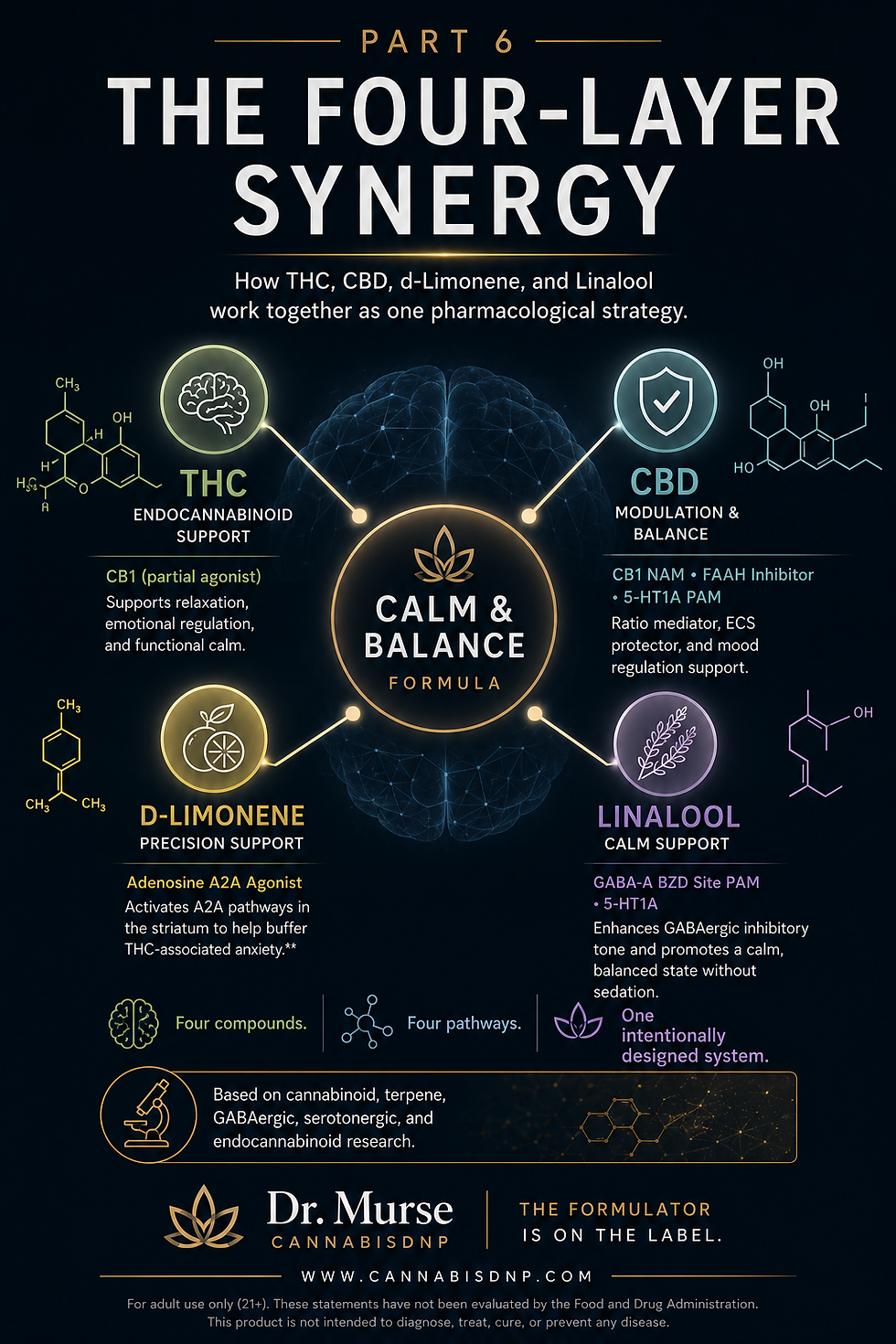
The mechanism: D-limonene activates adenosine A2A receptors in the striatum, triggering increases in dopamine and GABA. Dopamine for mood elevation. GABA for calm. Both
simultaneously. No sedation.
This is the first controlled human evidence that a cannabis terpene can selectively
modify a specific THC adverse effect without blocking therapeutic effects. For a formulator designing a daytime calm and balance product: this is exactly the kind
of evidence that belongs in the formulation decision.
D-limonene is the second most abundant terpene in cannabis. It's what gives citrus its
aroma. And it now has the strongest human clinical evidence of any cannabis terpene
for anxiety-relevant effects.
This is why it's in our formula.
Not because it smells nice.
Because the data supports it.
— Dr. Murse | CannabisDNP
The Formulator Is on the Label.
─────────────────────
For adult use only (21+) · Educational content only
References:
Spindle TR, Zamarripa CA, Russo E, Pollak L, Bigelow G, Ward AM, Tompson B, Sempio C, Shokati T, Klawitter J, Christians U, Vandrey R. Vaporized D-limonene selectively mitigates the acute anxiogenic effects of Δ9-tetrahydrocannabinol in healthy adults who intermittently use cannabis. Drug Alcohol Depend. 2024 Apr 1;257:111267. doi: 10.1016/j.drugalcdep.2024.111267. Epub 2024 Mar 13. PMID: 38498958; PMCID: PMC11031290.
Song Y, Seo S, Lamichhane S, Seo J, Hong JT, Cha HJ, Yun J. Limonene has anti-anxiety activity via adenosine A2A receptor-mediated regulation of dopaminergic and GABAergic neuronal function in the striatum. Phytomedicine. 2021 Mar;83:153474. doi: 10.1016/j.phymed.2021.153474. Epub 2021 Jan 21. PMID: 33548867.
Not intended to diagnose, treat, cure, or prevent any disease.


Comments