
Day 1 — Calm and balance Series Launch: The Question Nobody Asks About: Ratios


And most people — including most cannabis brands — have never thought about it that
way.
Here's what I mean.
When you combine THC and CBD in a specific ratio, you're not just mixing two
compounds. You're creating an entirely different pharmacological environment — one
where each cannabinoid shapes how the other behaves at the receptor level.
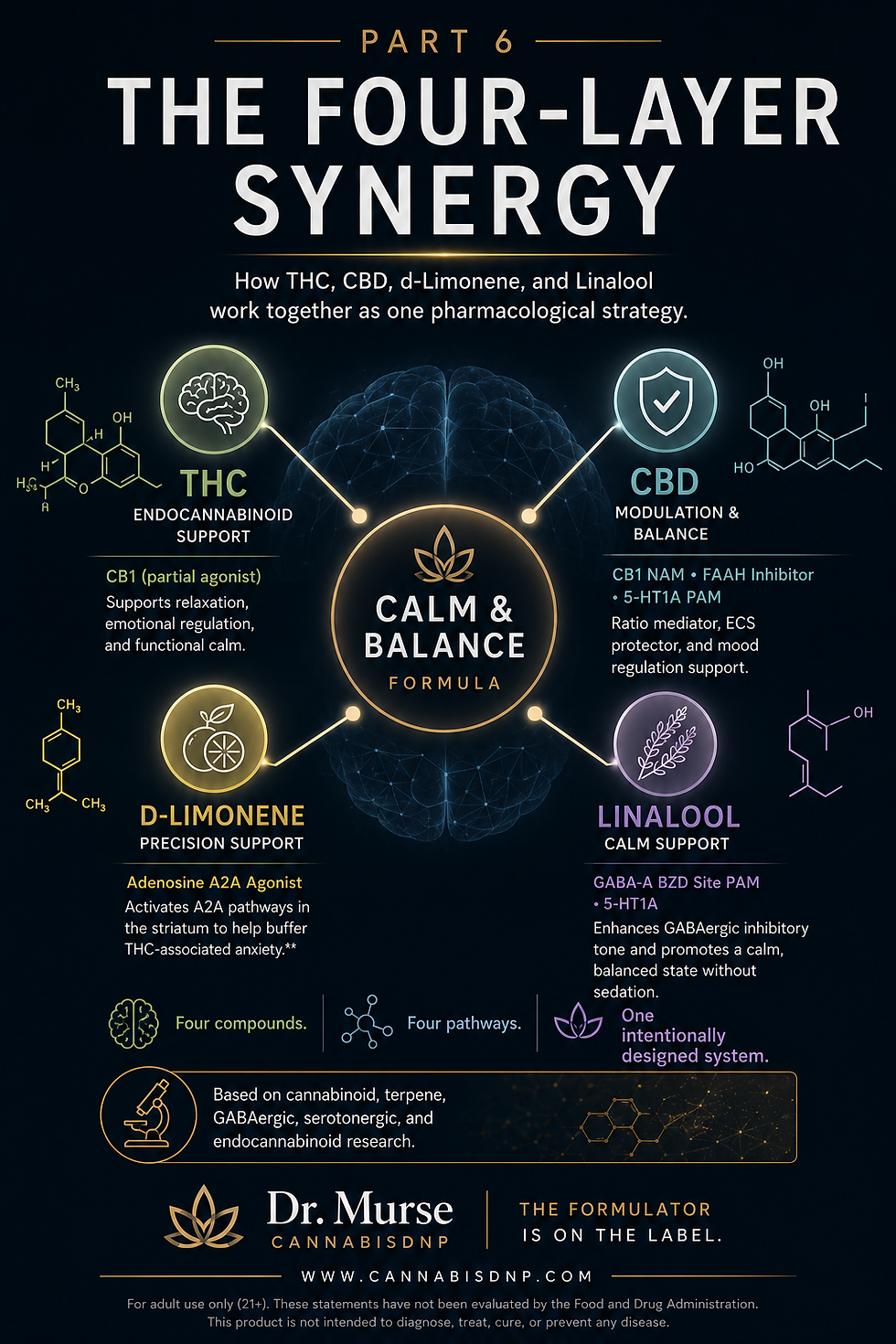
CBD acts as a negative allosteric modulator of the CB1 receptor. It doesn't block THC —
it changes the shape of the receptor, altering how THC binds and what it does when it
gets there. The result is a more balanced, nuanced experience than either compound
produces alone.
The research on this is real. The mechanism is documented. And most brands aren't
talking about it because understanding it requires knowing the science.
Over the next 10 days, I'm breaking down:
✦ Why stress depletes your endocannabinoid system — and what that has to do with
anxiety
✦ What CBD actually does at the molecular level (hint: it's not what most labels imply)
✦ Why a 1:1 THC:CBD ratio has a specific pharmacological rationale backed by human
data
✦ The two terpenes in our formula that have human clinical evidence — including a
landmark 2024 study from Johns Hopkins
✦ How four compounds working together produce something none of them could alone
If you followed the Sleep Series — welcome back. The science you learned there will
make this even richer.
If you're new here: I'm Dr. Murse. I'm a Doctor of Nursing Practice specializing in
cannabis therapeutics. I formulate the products. My name is on the label. And I believe
the people using these formulas deserve to understand exactly what's in them and why.
This is The Calm & Balance Series. Let us move on!
🧠— How Stress Works in Your
Body: The ECS Connection
Before we talk about cannabinoids, we need to talk about what stress actually does to
your brain.
When you perceive a threat — real or imagined — your hypothalamus activates your
HPA axis. Cortisol floods your system. Your nervous system shifts to sympathetic. Fight
or flight.
Brilliant for survival. Exhausting when it never turns off.
Here's what most people don't know: one of the first casualties of chronic stress is your
endocannabinoid system.
Research published in Translational Psychiatry confirmed that acute stress rapidly
depletes anandamide — your body's own "bliss molecule" — in the basolateral
amygdala. The same brain region that processes fear and anxiety. Lower anandamide
equals higher anxiety reactivity. This connection has been consistently replicated.
Anandamide is made on demand by your body. It binds to CB1 receptors — the same
receptors THC targets. But stress burns through it faster than your body can make it.
That's not a metaphor. That's a measured biochemical event.
Here's why it matters for formulation:
CBD inhibits FAAH — the enzyme that breaks down anandamide. When FAAH is
inhibited, more of your own natural anandamide stays active longer. Your body's stress-buffering system gets a chance to actually work.
This isn't CBD doing something new to your brain.
It's CBD protecting what your brain already makes.
That distinction matters. A lot.
Tomorrow: what CBD actually does at the receptor level — and why the "CBD blocks
THC" narrative is missing something important.
— Dr. Murse | CannabisDNP
The Formulator Is on the Label.
─────────────────────
For adult use only (21+) · Educational content only.
Reference:
Selemon LD. A role for synaptic plasticity in the adolescent development of executive function. Transl Psychiatry. 2013 Mar 5;3(3):e238. doi: 10.1038/tp.2013.7. PMID: 23462989; PMCID: PMC3625918.
Not intended to diagnose, treat, cure, or prevent any disease.


Comments