Part 5 — The Missing Piece Everyone Overlooks: Terpenes

Why formulation determines outcomes more than any single cannabinoid

The THC vs. CBN debate often proceeds as if these two cannabinoids operate in a biochemical vacuum — as if the only variable in a sleep formula is which cannabinoid is present. But any clinician working in cannabis medicine quickly learns that the terpene profile of a formulation does as much to shape the clinical experience as the cannabinoid content.
Terpenes are not merely aromatic molecules. After oral ingestion, they are absorbed through the GI tract, cross the blood-brain barrier by virtue of their lipophilicity, and directly engage receptor systems — GABA-A, serotonin, adenosine, and the endocannabinoid system — that are central to sleep-wake regulation. And in combination with cannabinoids, they appear to produce synergistic effects greater than either compound alone.
The Three Sleep-Relevant Terpenes in Dr. Murse's Rest & Restore Formula
🌿 Beta-Myrcene — The Serotonergic Sedative
Mechanism: A 2024 network pharmacology and in vivo study (Chen et al., Pharmaceuticals, PMC11434966) identified the serotonergic synaptic pathway as beta-myrcene's primary mechanism for sedative-hypnotic effects. In PCPA-induced insomnia mice, myrcene significantly reduced sleep latency and extended sleep duration through 5-HT (serotonin) pathway modulation — the same pathway targeted by many conventional sleep aids. Beta-myrcene also activates CB1 receptors at approximately 10–48% of THC's efficacy, contributing directly to the entourage effect when combined with cannabinoids (Raz et al., Biochem Pharmacol 2023).
Sleep relevance: Faster sleep onset, reduced nighttime arousal, muscle relaxation that reduces physical tension barriers to sleep. A 2023 double-blind human crossover study (Johnson et al., Cannabis) confirmed beta-myrcene produced meaningful CNS effects in people when given alone — establishing real-world pharmacological activity independent of cannabinoids.
💜 Linalool — The GABAergic Calming Agent
Mechanism: Linalool — the primary active constituent of lavender — is a positive allosteric modulator of GABA-A receptors, the brain's primary inhibitory receptor system. Its anxiolytic effects are blocked by flumazenil (a benzodiazepine antagonist), confirming it acts at the BZD binding site of GABA-A. Confirmed Mechanism This mechanism is the most rigorously characterized of any sleep terpene, supported by human randomized controlled trials of oral lavender preparations (Silexan) showing significant anxiety reduction in GAD — making linalool the most human-trialed sleep-relevant terpene available.
Sleep relevance: Linalool addresses the anxiety-driven insomnia phenotype directly. Many patients who struggle to sleep cite racing thoughts, worry, and mental hyperarousal at bedtime — linalool's GABAergic activity quiets this without the dependency risk of benzodiazepines. Combined with THC or CBN, linalool has also been shown to enhance CB1 receptor activation synergistically (Raz et al., 2023).
🌶️ Beta-Caryophyllene — The CB2 Anti-Inflammatory
Mechanism: Beta-caryophyllene (BCP) is uniquely distinguished as the only dietary terpene that functions as a selective full agonist at CB2 cannabinoid receptors (Gertsch et al., PNAS 2008). In animal pentobarbital sleep experiments, BCP reduced sleep latency — consistent with CB2-mediated sedation in the amygdala and limbic regions. A 2024 study confirmed BCP protects against cognitive impairment from sleep deprivation through CB2 mechanisms (Lim et al., Arch Pharm Res).
Sleep relevance: Many people with insomnia have a significant inflammatory or pain component — nighttime discomfort that prevents both onset and maintenance of sleep. BCP's CB2-mediated anti-inflammatory activity addresses this without psychoactivity. Its limbic CB2 engagement also directly supports the anxiety-reduction and mood-stabilization aspects of sleep preparation.
Why These Three Together?
The pairing of beta-myrcene, linalool, and beta-caryophyllene in a sleep formulation isn't arbitrary — it represents three distinct pharmacological pathways being engaged simultaneously:
Myrcene → serotonergic sedation (sleep onset) + CB1 synergy
Linalool → GABAergic calming (anxiety-driven insomnia) + CB1 amplification
BCP → CB2 anti-inflammatory (pain/discomfort) + limbic mood regulation
The 2023 Raz et al. study in Biochemical Pharmacology demonstrated that combinations of these terpenes with THC produced CB1 receptor activation several times greater than THC alone at physiologically relevant ratios — qualifying the interaction as genuine pharmacological synergy, not just additive effect. The 2021 LaVigne et al. study in Scientific Reports confirmed cannabis terpenes are "cannabimimetic and selectively enhance cannabinoid activity" in vivo. Formulation is where sleep medicine meets cannabis science.
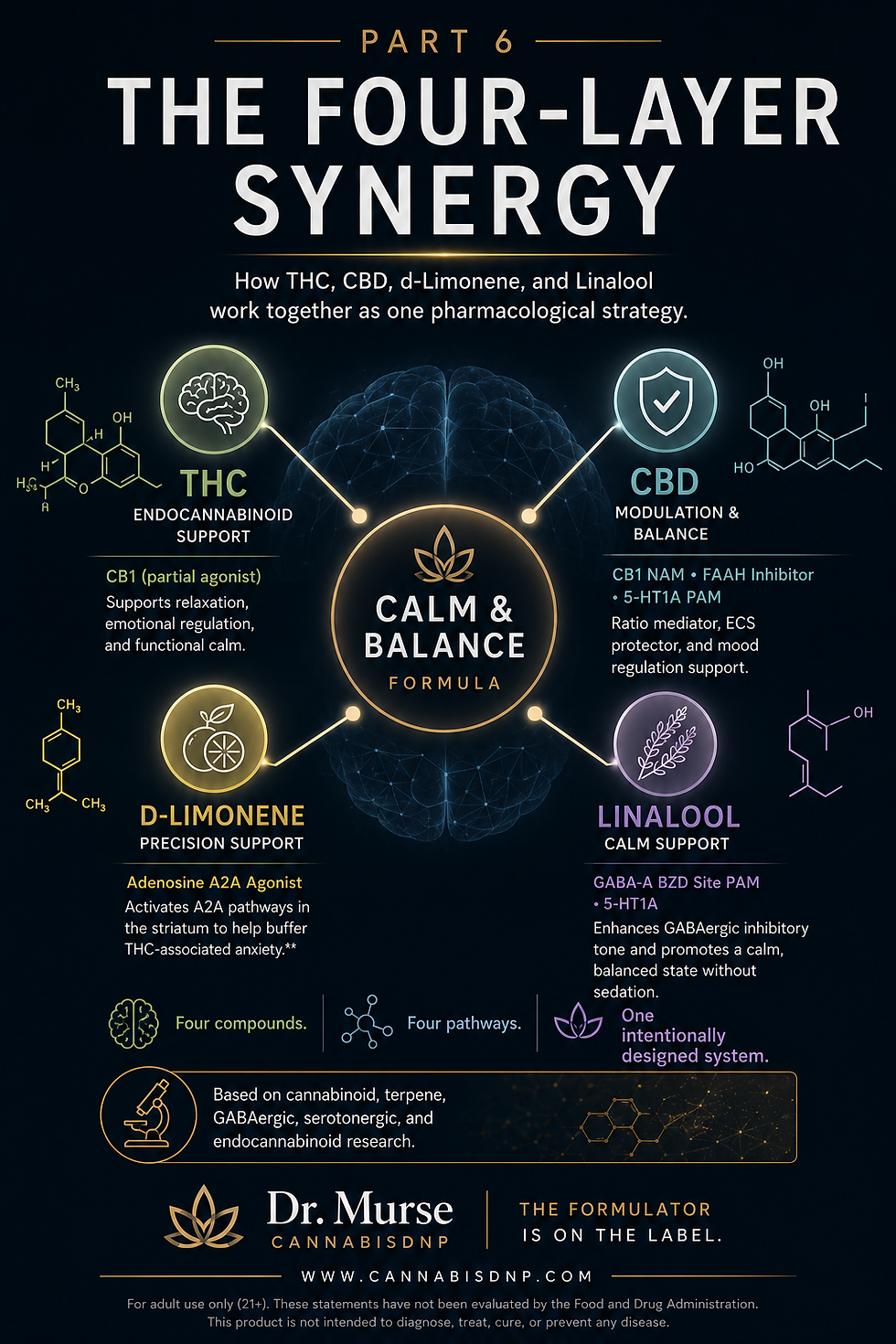
At Dr. Murse | CannabisDNP, this is exactly why we focus so heavily on formulation rather than chasing isolated cannabinoid trends. Sleep is not one-dimensional, and neither is cannabinoid science. The interaction between cannabinoids, terpenes, dose, timing, and individual physiology is where the real conversation begins — and where thoughtfully designed formulations can make the greatest difference. Our Rest & Restore Evening Formula was intentionally built around these principles: combining clinically informed cannabinoid dosing with terpene profiles selected for their complementary pharmacology and sensory experience. And we’re only getting started. With roughly four days remaining in our 10-Day Sleep Series, we’ll continue exploring the science behind sleep architecture, formulation strategy, receptor pharmacology, and the emerging evidence shaping the future of cannabinoid therapeutics. Because at Dr. Murse, education is not separate from the product — it is part of the product.


Comments