What Are Delta-8, HHC, THC-O, THC-P, and Delta-10 — and Why Does Dr. Murse Avoid Them?

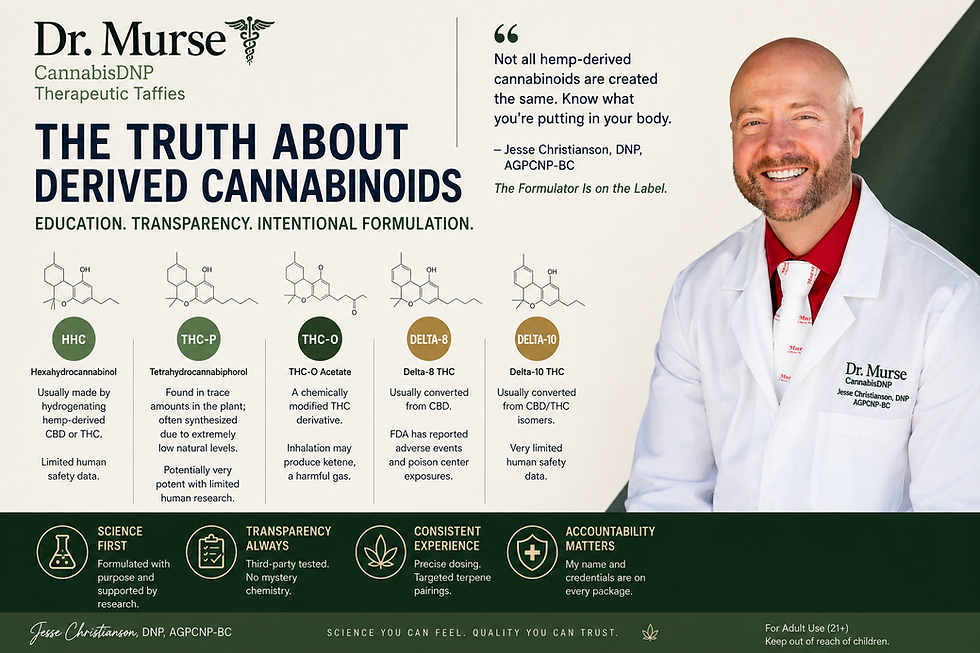
The hemp market has changed fast. After the 2018 Farm Bill, many companies began selling intoxicating cannabinoids that are often marketed as “hemp-derived,” “legal THC,” or “alternatives” to Delta-9 THC (the main psychoactive/intoxicating component). Some of these compounds exist naturally in Cannabis sativa L. in trace amounts. Others are created through chemical conversion from hemp-derived CBD or other cannabinoids. Chemical processes include Isomerization (conversion of the molecular structure), Cyclization (ring closure), Acid-Catalyzed Rearrangement (broader term used when acid helps rearranged the molecule), Regioisomerization (shifting the double-bond to a new location).
At Dr. Murse | CannabisDNP, this matters because our position is simple: we do not build products around novelty chemistry. We build around transparency, intentional formulation, and clinically informed decision-making.
The key distinction: naturally present vs. commercially produced
Many of these cannabinoids can be described as “found in cannabis,” but that does not mean the commercial product was simply extracted from the plant. In practice, most retail HHC, Delta-8 THC, Delta-10 THC, THC-O, and THC-P products are made by chemically converting hemp-derived CBD or other cannabinoids into the desired compound, then purifying the final material. A peer-reviewed paper proposed calling this broader class “derived psychoactive cannabis products” to distinguish them from naturally grown cannabis products.
That distinction is important because chemical conversion can introduce concerns that do not exist in the same way with straightforward plant extraction: residual acids, solvents, catalysts, byproducts, unknown reaction products, inaccurate labeling, and variable potency.
Quick Comparison
Cannabinoid | Naturally in plant? | How most products are made | Intoxicating? | Main clinical concern |
Delta-8 THC | Trace amounts | Usually converted from CBD | Yes | Poison center reports, labeling, contaminants |
Delta-10 THC | Trace amounts | Usually converted from CBD/THC isomers | Yes | Very limited human safety data |
HHC | Trace amounts/ oxidation-related | Usually hydrogenated from CBD/THC | Yes | Limited safety data, psychosis/ adverse-event concerns |
THC-O acetate | Not meaningfully natural as sold | Acetylated THC derivative (acetylation- chemically modified) | Yes, often potent | Legal uncertainty, inhalation/ ketene concerns (colorless/toxic) |
THC-P | Trace amounts | Often synthesized/ converted due to tiny natural levels | Yes, potentially very potent | High potency, limited human data |
Delta-8 THC
Delta-8 THC is a structural isomer of Delta-9 THC. It can occur naturally in cannabis, but usually only in very small amounts. Because natural extraction is not commercially practical at scale, most Delta-8 products are made by chemically converting hemp-derived CBD into Delta-8 THC.
From a clinical standpoint, the concern is not only the molecule. The concern is the marketplace around the molecule. FDA has specifically warned that Delta-8 THC products have not been evaluated or approved by FDA for safe use and may be marketed in ways that put public health at risk. FDA reported 104 adverse event reports between Dec. 1, 2020 and Feb. 28, 2022, including hallucinations, vomiting, tremor, anxiety, dizziness, confusion, and loss of consciousness.
CDC also issued a health advisory in 2021 after increasing availability of Delta-8 products and adverse events, including cases where people mistook Delta-8 products for CBD-like products and experienced cannabis intoxication symptoms.
A 2024 poison-center study reported 4,925 Delta-8 THC exposure cases in 2021–2022, with notable pediatric involvement and regional variation.
Delta-10 THC
Delta-10 THC is another THC isomer. Like Delta-8, it is generally present only in trace amounts naturally and is usually created through chemical conversion processes. Compared with Delta-8, the human research base is even thinner.
The practical concern is straightforward: consumers are buying products with psychoactive claims in a market where clinical evidence, standardized dosing, and long-term safety data are limited. Recent toxicology reviews have emphasized that newer THC isomers and hemp-derived intoxicants remain under-researched and inconsistently regulated.
For Dr. Murse education, Delta-10 is a useful example of why “new” does not automatically mean “better,” and why a brand should be able to explain what is in the product, why it is there, how it was made, and how it was tested.
HHC
HHC, or hexahydrocannabinol, is chemically similar to THC. It may occur naturally in cannabis in trace amounts, but commercial HHC is generally semi-synthetic and commonly produced by converting hemp-derived CBD or THC through hydrogenation chemistry. WHO’s critical review describes HHC as a semi-synthetic cannabinoid that may also be naturally present in trace amounts, and notes that marketed products may contain different epimers, including 9R-HHC and 9S-HHC.
Clinical concerns include limited human safety data, inconsistent product composition, intoxication risk, and psychiatric concerns in vulnerable individuals. A 2025 study on HHC use and harms in Ireland describes HHC as a semi-synthetic cannabinoid synthesized from CBD and notes reports of psychotic illness precipitated by HHC use.
A separate analysis of seized HHC products found extreme fluctuations in HHC content and detected Delta-9 THC in most seizures, underscoring the product consistency problem.
THC-O Acetate
THC-O acetate is an acetylated THC derivative. It is not the same thing as Delta-9 THC, Delta-8 THC, or standard hemp extract. It is usually made through chemical modification of THC or THC isomers.
The biggest clinical concern is inhalation. A Journal of Medical Toxicology article warned that vaping THC-O acetate may generate ketene, a highly toxic gas, raising concern for EVALI-like lung injury.
There has also been legal uncertainty. DEA issued a 2023 letter stating that Delta-8-THC-O and Delta-9-THC-O are controlled substances under federal law, though later court developments have created disagreement and uncertainty in some jurisdictions.
For Dr. Murse education, THC-O is a strong example of why “hemp-derived” does not automatically mean simple, natural, low-risk, or clinically appropriate.
THC-P
THC-P, or Delta-9-tetrahydrocannabiphorol, is a phytocannabinoid first isolated and characterized in 2019. The original Scientific Reports paper described THC-P and CBDP as newly identified heptyl homologs (seven-carbon chain to increase binding to the receptor) of THC and CBD, and found THC-P produced THC-like cannabimimetic activity in animal testing.
THC-P is often discussed as highly potent because of strong CB1 receptor activity, but that does not mean it is well understood in humans. Natural levels appear extremely low, which means most commercial THC-P products are likely produced through synthesis or conversion rather than simple extraction.
Clinical concern: high potency plus limited human safety data is not a great combination. Small dosing errors can matter more when a compound is more potent, and consumers may not understand what they are taking.
These compounds require more transparency, more testing, and more clinical humility than the market often gives them.
Key concerns:
1. Conversion chemistry: Many products begin with CBD and are chemically converted. That creates a need for rigorous testing beyond basic potency.
2. Residual contaminants: Acids, solvents, catalysts, heavy metals, and unknown byproducts may be present if manufacturing is poor.
3. Label accuracy. Consumers may not receive what the label claims, especially in loosely regulated channels.
4. Pediatric exposure, FDA and FTC have repeatedly warned companies selling Delta-8 products in packaging that mimics popular snacks, emphasizing risk to children and consumer confusion.
5. Psychiatric and neurologic effects. Intoxicating cannabinoids can produce anxiety, confusion, paranoia, sedation, impaired coordination, and in some cases may worsen psychiatric vulnerability.
6. Drug testing: HHC and other THC-like compounds may still create positive THC metabolite findings; WHO’s HHC review notes evidence suggesting HHC exposure could cause a positive THC-COOH reading without Delta-9 THC consumption.
7. Dose stacking Edibles have delayed onset. Consumers may take more before the first dose peaks, increasing risk of unpleasant intoxication.
Dr. Murse does not chase the newest intoxicating cannabinoid. We focus on intentional formulations, clear labeling, consistent dosing, and third-party testing.
We use Delta-9 THC, CBD, CBG, and targeted terpenes with a clear formulation purpose. No Delta-8. No THC-P. No THC-O. No HHC. No mystery chemistry.
In a market crowded with “new cannabinoids,” Dr. Murse offers a more disciplined path: clinically informed products built for adults who want clarity, accountability, and repeatable experiences.
Reference list
FDA. “5 Things to Know about Delta-8 Tetrahydrocannabinol – Delta-8 THC.”
CDC Health Alert Network. “Increases in Availability of Cannabis Products Containing Delta-8 THC and Reported Cases of Adverse Events.”
Smith GA, et al. “Delta-8 Tetrahydrocannabinol Exposures Reported to US Poison Centers…” Journal of Medical Toxicology, 2024.
Kruger DJ, et al. “Delta-8, Delta-10, HHC, THC-O, THCP, and THCV: What Should We Call These Products?”
Benowitz NL, et al. “Vaping THC-O Acetate: Potential for Another EVALI Epidemic.” Journal of Medical Toxicology, 2022.
Citti C, et al. “A novel phytocannabinoid isolated from Cannabis sativa L. with an in vivo cannabimimetic activity higher than Δ9-THC.” Scientific Reports, 2019.
WHO Expert Committee on Drug Dependence. “Hexahydrocannabinol Critical Review.”
Mongan D, et al. “Hexahydrocannabinol (HHC) use and harms in Ireland.” 2025.
Hundertmark M, et al. “Characterising a New Cannabis Trend: Extensive Analysis of HHC Products.” 2025.
FDA/FTC. “FDA, FTC Continue Joint Effort to Protect Consumers Against Companies Illegally Selling Copycat Delta-8 THC Food Products.”


Comments