
Cannabinoids Across Disease States: A Clinically Informed Overview

Educational content only. Not medical advice. Cannabinoid therapy should always be personalized and discussed with a qualified healthcare professional, especially when considering current medications, past medical history, or complex medical conditions.
At Dr. Murse / CannabisDNP, we approach cannabinoid therapeutics the same way we approach primary care: individualized, clinically informed, and intentionally dosed. Cannabinoids are not a one-size-fits-all solution—and they should never be treated as such.
This month, we’ll be exploring a variety of disease states and symptom clusters where cannabinoids may play a supportive role. Today, we’re only touching the surface. As the month snowballs on, we’ll continue to expand on specific conditions, dosing considerations, and clinical nuance.
Our goal is education—not hype—and empowerment through evidence-informed discussion.
The Endocannabinoid System: A Brief Foundation(Refresher from previous posts)
The endocannabinoid system (ECS) is a regulatory network involved in maintaining balance (homeostasis) across multiple body systems, including:
Mood and emotional regulation
Pain perception
Inflammation and immune signaling
Sleep–wake cycles
Stress response and memory
Some clinicians and researchers use the term Clinical Endocannabinoid Deficiency (CED) to describe states in which the ECS may be under-functioning. This deficiency may be:
Genetic or congenital
Acquired after injury or illness
Associated with chronic stress or trauma
While CED is still an evolving concept, emerging research suggests ECS dysregulation may be involved in conditions such as mood disorders, anxiety disorders, and PTSD.
Depression, Anxiety, and Mood Regulation
Mood disorders are complex and multifactorial. Neurotransmitters such as serotonin, dopamine, glutamate, and GABA all play key roles—and the ECS interacts with each of these systems.
Depression
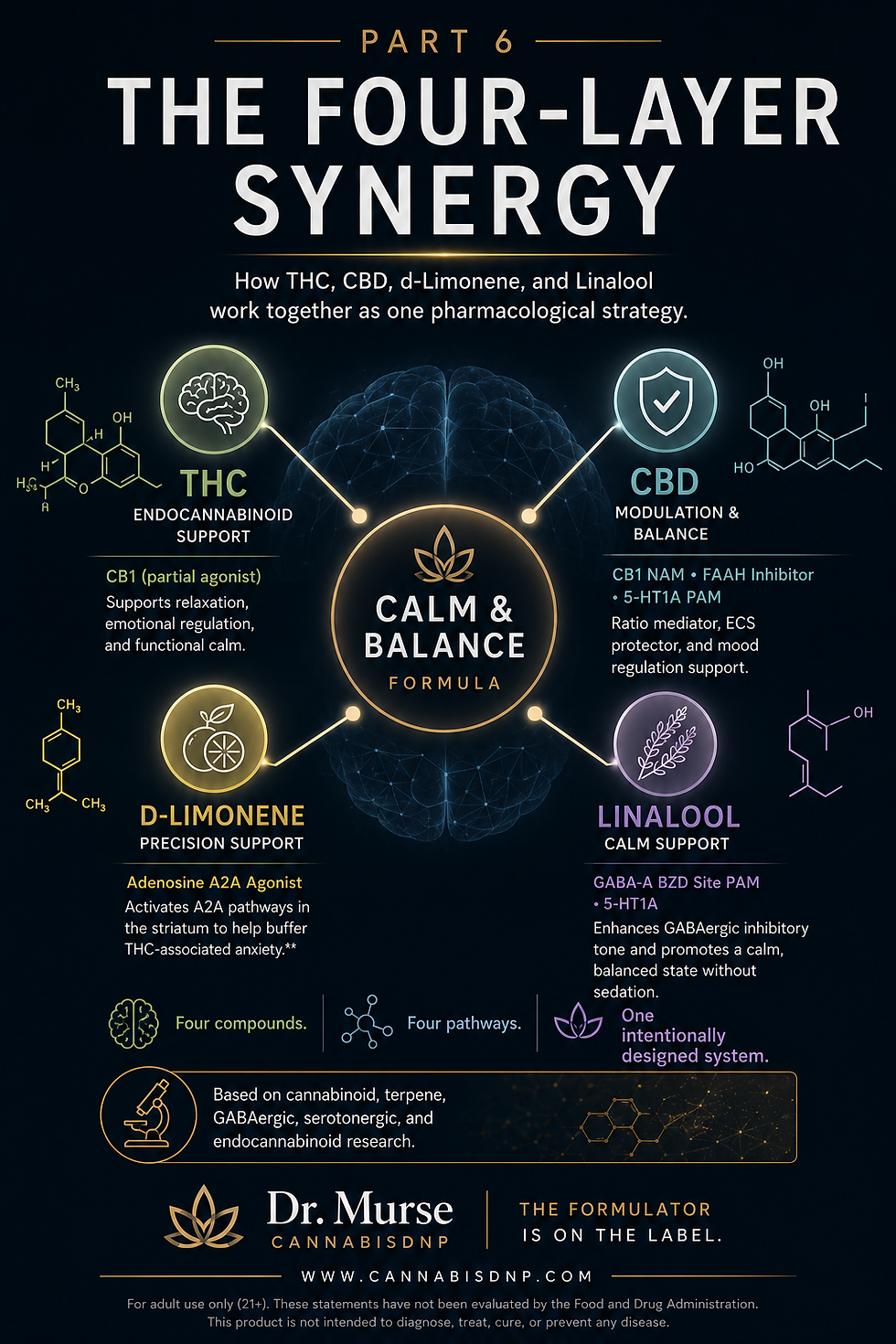
Depression is often associated with reduced serotonin and dopamine signaling. Cannabinoids—particularly THC—have been shown in research settings to interact with the 5-HT1A serotonin receptor, a receptor also targeted by several conventional antidepressants.
THC may also inhibit serotonin reuptake, which can increase serotonin availability in the synaptic space. For some individuals, this mechanism may contribute to improved mood or emotional regulation when used carefully and at appropriate doses.
Important note: Higher doses are not better. Excessive THC can worsen anxiety, mood instability, or motivation in certain individuals. The ECS is very sensitive and, usually, only needs a slight nudge.
Anxiety and the Stress Response
Anxiety can often be understood through the lens of neurotransmitter balance:
Glutamate: the brain’s “gas pedal”
GABA: the brain’s “brake pedal”
Low GABA activity or excessive glutamate signaling—particularly in the amygdala, the brain’s fear-processing center—can contribute to heightened anxiety.
THC has been shown to inhibit glutamate release in the amygdala, allowing GABA levels to build and exert a calming, inhibitory effect. This mechanism may help explain why low, carefully titrated doses of THC can feel calming for some individuals.
However, dose sensitivity is critical. Too much THC may have the opposite effect and increase anxiety or panic.
PTSD and the Endocannabinoid System
Post-traumatic stress disorder has been associated with measurable changes in the ECS. Research has demonstrated:
Decreased levels of anandamide (AEA) in cerebrospinal fluid
Altered ECS signaling on imaging studies
Anandamide—often referred to as the “bliss molecule”—plays a role in emotional processing, fear extinction, and stress recovery. Supporting ECS tone through carefully selected cannabinoids may offer symptom relief for some individuals when integrated thoughtfully and responsibly.
Why Personalization Matters
Cannabinoid therapeutics must always consider:
Current medications (including SSRIs, benzodiazepines, antipsychotics, and pain medications)
Past medical history
Mental health history
Age, metabolism, and tolerance
This is why clinically dosed formulations matter.
At Dr. Murse / CannabisDNP, our therapeutic taffies are:
Intentionally dosed
Designed with clinical reasoning
Created to support consistency and predictability
They are not designed for intoxication—they are designed for therapeutic intent.
You can learn more about our clinically informed formulations at www.cannabisdnp.com.
What’s Coming Next
This is just the beginning.
Over the coming weeks, we’ll continue to explore:
Specific disease states
Cannabinoid and terpene considerations
Practical dosing discussions
Safety, interactions, and clinical boundaries
Education builds safety. Personalization builds trust. And thoughtful dosing builds better outcomes.
Stay curious. Stay informed. And always start low and go slow.
— Dr. Murse / CannabisDNP


Comments