Anxiety & the Endocannabinoid System: What the Science Acknowledges


Written by Jesse Cole Christianson, DNP, APRN, AGPCNP-BC Board-Certified Nurse Practitioner | Cannabinoid Science Educator | Founder, Dr. Murse/CannabisDNP
If you've ever felt your heart racing before a big presentation, or found yourself lying awake at 2am replaying a conversation from three days ago — you already know what anxiety feels like in your body. What you might not know is that your brain has a built-in system designed to calm that response down. And that system is at the center of some of the most interesting cannabinoid research happening right now.
As a Doctor of Nursing Practice with advanced training in cannabinoid science, I created Dr. Murse/CannabisDNP to bridge the gap between the research and the people who could benefit from understanding it. This post is part of that mission. Let's dig in.
What Is Anxiety, Really?
Anxiety is the most common mental health condition in the United States, affecting approximately 40 million adults. (NIMH, 2023)
Feeling anxious sometimes is entirely normal — it's your nervous system doing its job. Your brain's alarm center, the amygdala, detects a potential threat and triggers a cascade of stress chemicals including cortisol and adrenaline. Your heart rate rises, your muscles tighten, and your brain shifts into fight-or-flight mode. In genuine danger, this is a feature, not a flaw.
The challenge with anxiety disorders is that this alarm becomes oversensitive. It fires frequently, intensely, and often without a proportionate trigger — leaving the body in a prolonged state of physiological stress that affects sleep, digestion, focus, relationships, and overall quality of life.
Common presentations include generalized anxiety, social anxiety, panic disorder, PTSD, and phobia-related anxiety. Each has a different profile, but they share a common thread: the brain's threat-response system is working harder than the situation requires.
Your Brain's Built-In Calming System
Here's something most people don't know: your body already has a system whose job is to put the brakes on that alarm response. It's called the endocannabinoid system (ECS).
The ECS (just the basics here) is a complex cell-signaling network woven throughout your brain and body. It operates through two primary receptor types — CB1 (concentrated in the brain and central nervous system) and CB2 (found primarily in immune tissues and peripheral nerves). Your body produces its own cannabinoid-like molecules — called endocannabinoids — that naturally bind to these receptors.
One of the ECS's most well-documented roles is fear extinction — the brain's process of learning that a past threat is no longer dangerous. CB1 receptors in the amygdala, prefrontal cortex, and hippocampus are directly involved in this process. When functioning well, the ECS helps your brain move from "this is dangerous" to "this is safe" more efficiently.
Research published in NIH/ScienceDaily (2023) confirmed something remarkable: when you're under significant stress, your brain actually releases its own endocannabinoids as a self-regulating response — essentially deploying its own calming chemistry. This is one reason why the relationship between the ECS and anxiety has become such an active area of scientific investigation.
What the Research Says About CBD, THC, and CBG
Plant-derived cannabinoids interact with the same ECS that your body uses to regulate stress. Here is a plain-language summary of the most current peer-reviewed findings:
CBD (Cannabidiol)
CBD is one of the most studied cannabinoids in relation to everyday calm and the brain's stress response systems. What makes it particularly interesting to researchers is where it works.
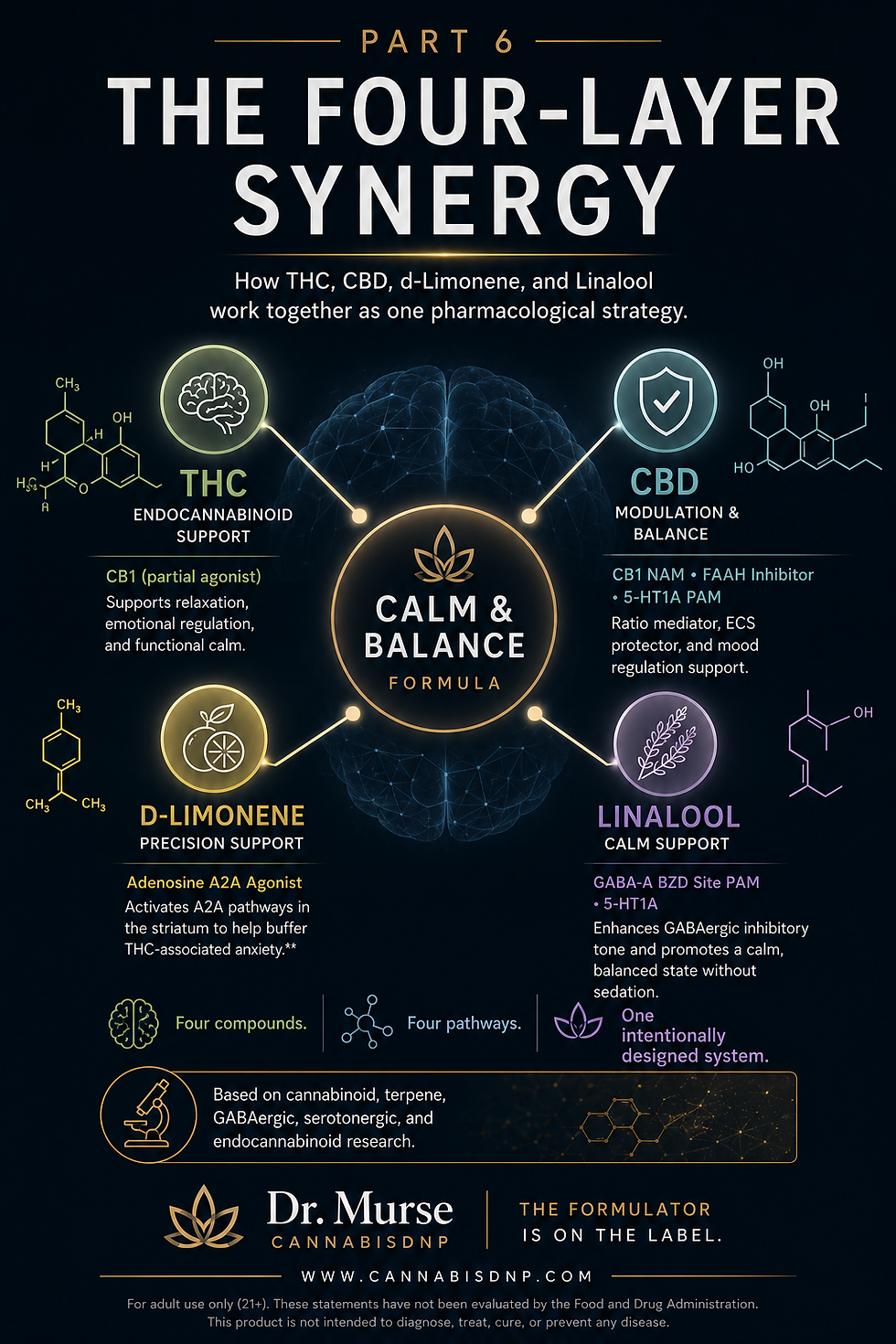
CBD interacts with 5-HT1A serotonin receptors — the same receptors targeted by buspirone, a commonly prescribed non-addictive calming medication, and by SSRIs. Activating 5-HT1A receptors in the brain's amygdala and prefrontal cortex is associated with a more regulated emotional state. CBD also functions as a negative allosteric modulator at CB1 receptors — meaning it doesn't activate the receptor directly, but may influence how the receptor responds to other compounds. Remember, dose matters.
The clinical research is growing rapidly:
A 2024 meta-analysis from Stanford University (Psychiatry Research, Han et al.) reviewed 8 studies with 316 participants and found CBD produced a Hedges' g of −0.92 (VERY substantial)— one of the largest effect sizes reported in this area of research
A 2024 systematic review (Life Journal, Coelho et al.) analyzed 15 randomized controlled trials from 2013–2023 and found CBD consistently reduced anxiety compared to placebo, with minimal side effects
A 2023 double-blind trial (Psychopharmacology, Gournay et al.) found that adults with elevated worry who received 300mg CBD showed meaningful reductions in worry scores compared to placebo
CBD does not produce intoxicating effects at typical serving sizes and does not cause a "high", but it is psychoactive.
Delta-9 THC
THC's relationship with everyday calm is more nuanced and dose-dependent. THC binds directly to CB1 receptors in the brain's amygdala — the same region involved in processing threat and fear responses. At low doses, this interaction may support a calmer, more settled state of mind. At higher doses, THC can over-activate CB1 receptors and paradoxically increase feelings of unease in some individuals. Also known as the biphasic effect.
This is precisely why formulation and dosing matter. The Dr. Murse Hemp-derived Delta-9 THC products keep this dose range intentionally low and controlled — which is a meaningful clinical consideration, not just a legal technicality.
CBG (Cannabigerol) — The Newest Frontier
CBG is where the science gets genuinely exciting. Unlike CBD and THC — which work primarily through the ECS — CBG operates through a different and largely distinct set of mechanisms.
CBG has demonstrated affinity for alpha-2 adrenoceptors in the brain's locus coeruleus, the region responsible for releasing noradrenaline — the chemical that keeps the brain's alarm system activated. By acting at these receptors, CBG may help quiet the noradrenaline-driven arousal that characterizes anxiety. CBG also interacts with 5-HT1A receptors, adding a serotonin-adjacent dimension to its profile.
The landmark study in this area is the first-ever human clinical trial on CBG and anxiety, published in Nature: Scientific Reports in July 2024 by researchers at Washington State University (Cuttler et al.). Here is what they found:
34 adults received either 20mg CBG or placebo
The CBG group showed a 26.5% reduction in anxiety ratings at 20, 45, and 60 minutes post-consumption
Zero impairment — participants reported no intoxication or "high"
Verbal memory actually improved in the CBG group — an unexpected and notable finding
A prior survey of 127 CBG users found 78% rated CBG as more effective than conventional approaches for everyday calm (Kaufman et al., Cannabis and Cannabinoid Research, 2021)
This is genuinely new science, and it reinforces why CBG has been incorporated into Dr. Murse/CannabisDNP formulations.
How It All Works Together
The brain pathway from stress to calm — simplified:
Perceived threat → Amygdala fires, cortisol and adrenaline flood in → CBD at 5-HT1A calms the serotonin pathway → CBG at alpha-2 adrenoceptors reduces noradrenaline release → CB1 receptors in the amygdala support the fear extinction process → Terpenes like linalool may interact with GABA receptors — the brain's primary "slow down" signal → Net effect: a quieter, more proportionate alarm response
This is why formulation matters — combining cannabinoids and terpenes thoughtfully, rather than relying on a single compound, reflects how the ECS actually functions. It's a system, not a single switch.
Terpenes Worth Knowing
The terpenes selected in Dr. Murse/CannabisDNP formulations aren't decorative — they're chosen with the emerging science in mind:
Linalool (lavender, hemp) — Being studied for its interaction with GABA pathways and the 5-HT1A receptor
D-Limonene (citrus, hemp) — Being studied for its relationship with serotonin and dopamine signaling and everyday mood
Beta-Caryophyllene (black pepper, hemp) — The only known terpene that directly binds CB2 receptors. Being studied for its relationship with neuroinflammation and stress response
Alpha-Pinene (pine, hemp) — Being studied for its relationship with cognitive clarity and alertness during periods of high stress
Terpinolene (apples, hemp) — Being studied for its potential role in the body's relaxation response
Together with cannabinoids, these compounds may interact through what researchers call the synergistic effect — the concept that whole-plant compounds work more effectively in combination than in isolation.
Other Approaches That Work — No Supplements Required
As a healthcare provider, my commitment is to your whole picture — not just to what we sell. The following approaches have strong, peer-reviewed evidence behind them and work independently of any supplement:
Cognitive Behavioral Therapy (CBT) — The clinical gold standard for anxiety. A 2023 meta-analysis of 10 studies with 1,250 participants showed meaningful, lasting reductions in anxiety symptoms (Bhattacharya et al., Current Psychiatry Reports, 2023)
Mindfulness-Based Stress Reduction (MBSR) — Reduced anxiety as effectively as CBT (Cohen's d = 1.06) in a large review, with results persisting beyond the program (PMC review, 2023)
Regular exercise — Both aerobic and resistance training significantly reduced anxiety symptoms across multiple studies, including in older adults (Kowalski et al., PMC, 2024)
Diaphragmatic breathing — Clinically proven to reduce heart rate and cortisol. Free, immediate, and available anywhere
These tools and cannabinoid education are not mutually exclusive. The most informed approach is one that understands all of your options.
About Dr. Murse/CannabisDNP
Dr. Murse/CannabisDNP was founded by Jesse Cole Christianson, DNP, APRN, AGPCNP-BC — a board-certified Nurse Practitioner with advanced training in cannabinoid science and pharmacology. Every product in our lineup is developed with evidence-informed formulation principles, manufactured in an FDA-registered GMP-certified facility, and independently tested by ISO/IEC 17025-accredited laboratories.
Our current hemp wellness blends include:
Calm & Balance — 10mg Delta-9 THC + 10mg CBD | Terpenes- D-limonene and Linalool | Raspberry | Daytime
Rest & Recovery — 10mg Delta-9 THC + CBD blend | Terpenes- Beta-myrcene, Beta-caryophyllene, Linalool | Black Cherry | Nighttime
Daylight Harmony Blend No. 1 — 20mg CBD + 20mg CBG | Terpenes- Alpha-pinene, Terpinolene, D-limonene | Strawberry | THC-Free
All products are vegan, Farm Bill compliant (≤0.3% Δ9-THC by dry weight), and available at cannabisdnp.com.
Education over hype. Care over claims. Stay interested. Stay teachable.
DISCLAIMER: These statements have not been evaluated by the Food and Drug Administration. Our products are not intended to diagnose, treat, cure, or prevent any disease. For adult use only (21+). Consult your personal healthcare provider before use, especially if pregnant, nursing, or taking prescription medications. The information in this post is intended for educational purposes only and does not constitute medical advice.


Comments